Publications on Álamos
Katherine supervises a student making a sketch of the church.
Otilia Urrea de Figueroa
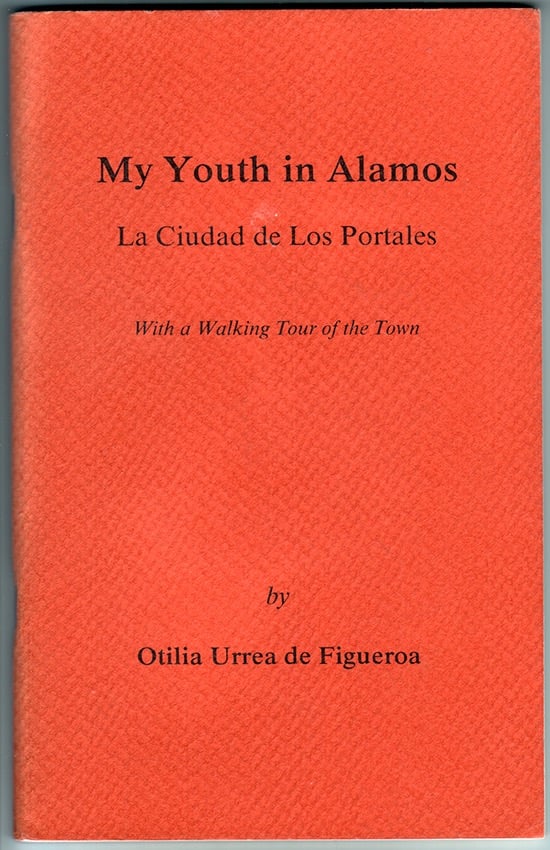
Otilia Urrea de Figueroa published this 74-page book in 1983, telling about her childhood in Álamos in the days before the revolution. She treasured the time she spent at “La Colorado,” where her father owned the Urrea Hermanos distillery, and she relates many details about her friends, her education, her family, and the traditions followed by the alamenses.
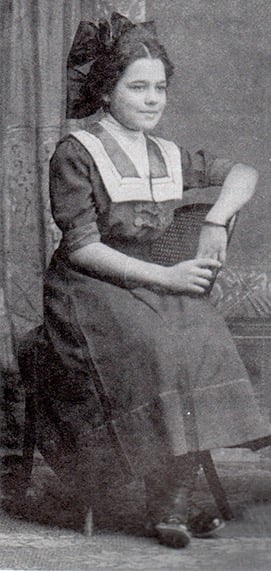
Born in 1896, she enjoyed a life of wealth and privilege–-which abruptly ended with the Mexican revolution (1910-1920). Her father, Miguel C. Urrea Perron, was one of the Álamos elites, owning both a sucessful business and a large cattle ranch. He was involved in national politics, and in 1910 he organized a reception for presidental candidate Francisco I. Madero at his Álamos home, which now has the address of #4 Obregón Street. During the formal occasion of the dinner and dance, 14-year-old Otilia played a piano solo for the future president and his wife, Sara. Her picture to the right was taken at that age.
As the government of Mexico disintegrated into rebel groups fighting for power, the Urrea family lost nearly everything. Otilia writes on Page 32:
“In 1917 Plutarco Elías Calles was elected governor of Sonora and declared the state ‘dry.’ The Urrea Hermanos distillery as ordered closed and consequently the mezcal plantations were not kept up. Our ranch, the Carrizál, had also been vandalized by the revolutionariea, who cleaned it completely of cattle…..We did not take any more trips to our place in the mountains of which we were so fond because that also was taken from us…..”
One by one members of the Urrea family left Álamos to begin new lives in the United States. Otilia left for Los Angeles in 1918—then 22 years old—and remained in southern California the rest of our life. She died in Glendale, CA, in 2001 at the age of 104.
Otilia visited Álamos for the last time in 1990 when she was 94 years old. On that visit, she was interviewed by Bev Krucek of the History Association, which you can read on the interview section of this website.
________________________
________________________
Álamos, Sonora, Mexico
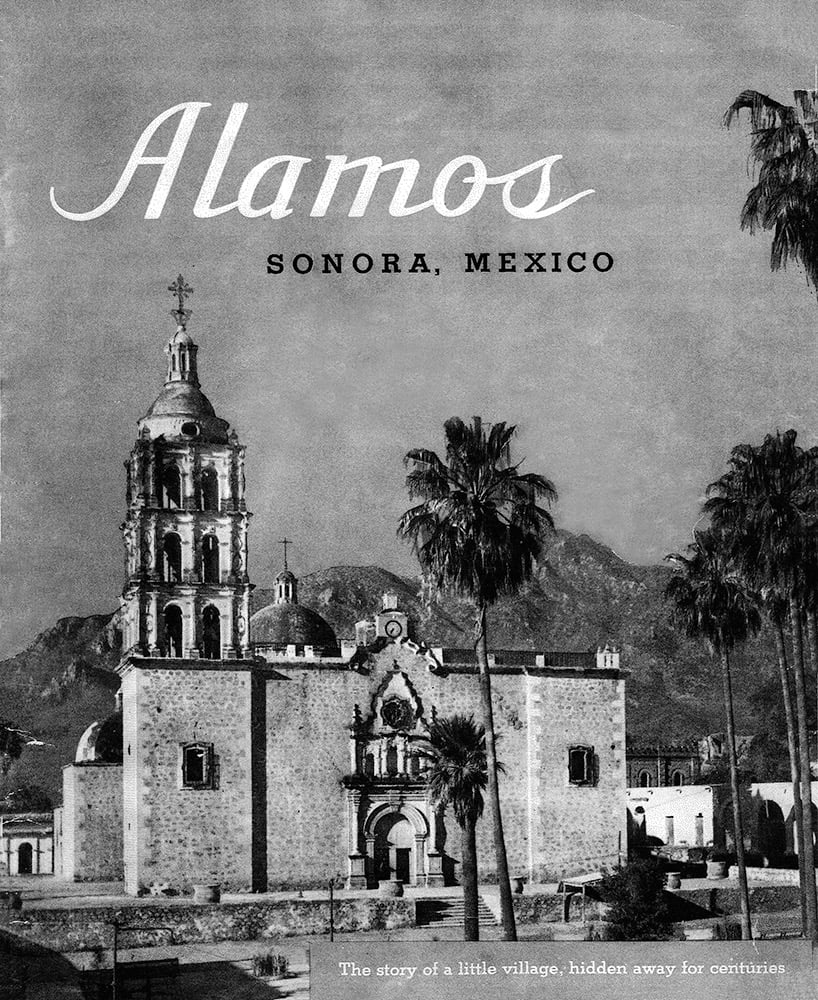
This booklet appeared in 1954, published by Peterson-Schon Company in Portland, Oregon, and written by Harvy A. Harris and Charles J. Marx. It gave a history of Álamos, and also had some pictures and information on Navojoa and Hermosillo. On the final page were pictures and short biographies of the president of Mexico, Don Adolpho Ruiz Cortines, and Sonora’s governor at that time, Don Ignacio Soto.
The 32-page publication serves as a tourist promotion for Álamos by describing the climate, the architecture, and the benefits of exploring the state of Sonora. It also discusses the region's history, with sections on pre-colonial life, the conquest of Mexico in 1519 by Herrnán Cortez which led to the discovery of gold and silver in Sonora, the great wealth of Álamos in thr 18th and 19th centuries, and it rapid decline in the first half of the 20th Century.
The pictures are an important part of the booklet's importance. No credits were provided for the photographs, and some images appear to have been taken in the 1930s and 1940s—although most were taken in the 1950s . In 2009 the History Association "retook" all the pictures included to show the changes in Álamos from ther time of the book's publication, and some of these "then and now" comparisons appear after the booklet's presentation.
Samuel Cabot Sedgwick
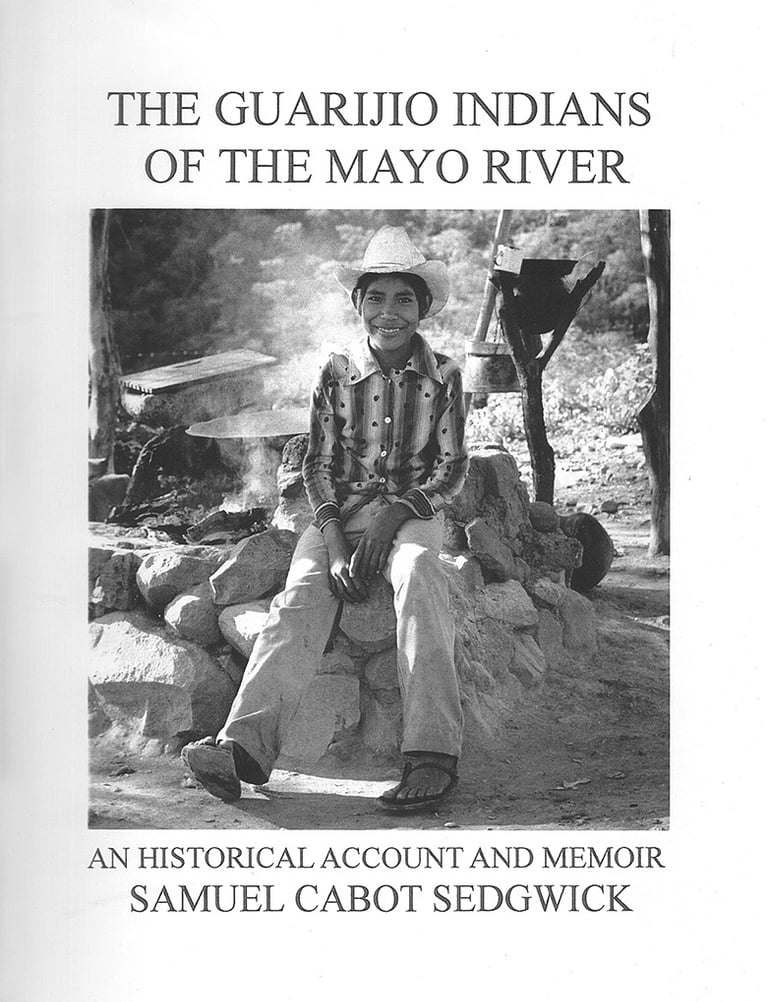
Sam Sedgwick, and Arizona rancher who enjoyed traveling in Mexico, made many trips between 1993 - 1998 to the Guarijío indigenous community in the mountains north of Álamos. He had learned of the Guarijíos through the writings of geographer and ethnographer Carl Sauer as well as the cultural documentation provide by Howard Scott Gentry during his travels in Guarijío country during the 1930s and 1940s. In 1942 Gentry published Río Mayo Plants of Sonora-Chihuahua, which became a classic work in the field of botany. What Sedgwick appreciated, though, was Gentry references to Guarijío culture and his understanding of people and social structure within this community.
The Guarijío, who reside in numerous small communities north of San Bernardo, Son., have been suspicious of “outsiders” since the Spanish came in the 16th Century and introduced them to a new religion and way of life. Their response was to go into hiding, the same response as their indigenous neighbors the Tarahumara, and their remote mountain environment enabled them to live into the 1970s much as their ancestors did for hundreds of years before the Spanish arrived. When Sedgwick first approached the tribe in 1993, he needed the assistance of the community leaders (gobernadores) to gain access to the people. Sedgwick, in his introduction, thanks many of these governors for the success that he had, including Rafael Méndez at Los Bajíos, former Instituto Nacional Indigenista director Leobardo Quiroz at San Bernardo, Ricardo Valenzuela Flores of San Bernardo, and Javier and José Zazueta of Mesa Colorado.
During his visits over a five-year period Sam tried to help the Guarijío improve the profitability of their ranches. They raised cattle in the high sierras, which they then sold to Mexican cattle traders at a very low
price. Sedgwick’s plan was for the Guarijío ranchers to drive their cattle to a holding ranch in San Bernardo, then transport the cattle to the U.S. border by truck and sell them directly to American beef importers. Sedgwick had only limited success during the five years he worked with the tribe, but his ideas have had a long-term effect.
Sedgwick was also helped in this endeavor by his wife, the former Guillermina Arenas (Mina) whose parents lived in Navojoa, Sonora. Using Navojoa as a home base, it was much easier for him to make numerous trips to Mesa Colorado and beyond. His wife was often at his side on these trips, and when Sedgwick died in 2002 his wife was instrumental in getting his memoir published. Mina also provided many of the pictures used in the book.
What stands out in the book is Sedgwick’s description of his travels by horseback into the Guarijío communities—especially those as isolated as Los Bajíos. This community of 200 was only accessible by horseback, a day’s ride from Guajaray and far from the conveniences of modern life. Sedgwick loved the people and their way of living in these remote mountain areas, and his goal was to bring a higher standard of living to Guarijío people.
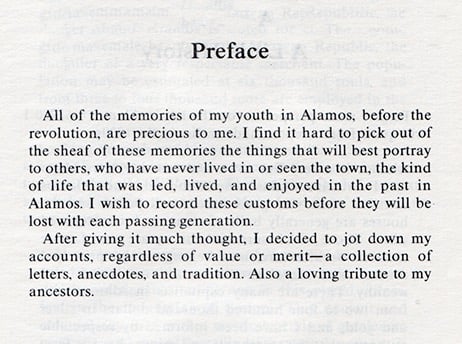
This book of 90 pages and 22 full-page photographs is available in the Álamos History Association research library, and please click on the button below to see selected portions of this publication.
My Youth in Álamos
________________________
'Sonora is Jumping'
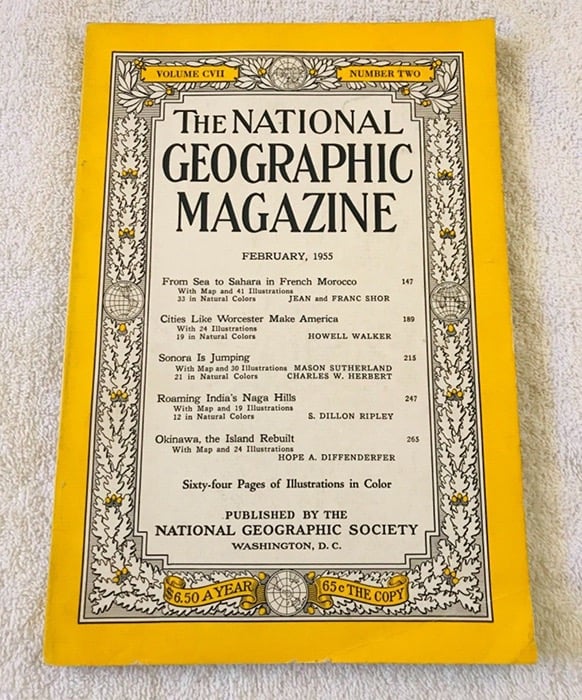
For Levant Alcorn and others in our community trying to encourage foreigners to travel to Alamos, buy homes, and enjoy a life of ease in the charm of Mexico, the National Geographic piece in February, 1955, was a "gift from above." While the 33-page story had pictures and information on Hermosillo, Guaymas, the vaquero lifestyle in the ranching community and much more, Álamos had a starring role in the copy written by Mason Sutherland and the beautiful photographs taken by Charles W. Herbert.
The story begins at the Plaza de Armas where Sutherland describes a Sunday evening promenade with ladies going in one direction around the plaza, and gentlemen the other. A rooftop picture on page 230 shows this stroll with the church in the background, but the photo was taken in the bright light of early afternoon. A picture on page 231 shows seven beautiful young ladies of Álamos posing at the kiosk, and other photographs show burros with firewood, a shoeshine boy, a landscape view from La Campana, Yaqui Indians wearing masks during lenten ceremonies, and a photo of Álamos resident Alberto Maas prospecting for minerals. The cactus growing out of the wall in the Balvanera Church in La Aduana also appears in a photograph.
In reading material written more than 70 years ago, it is impossible not to note the many changes that have taken place in Álamos. The cobblestones have been replaced by pavement, and burros with firewood are seldom seen on streets crowded with cars and trucks. The brays of donkeys and the chirping of birds are often replaced by the roar of motorcycles and cars playing music at a high volume. Times may have changed in Álamos, but during early morning walks today it is not hard to visualize the look and feel of this town described by Sutherland photgraphed by Herbert in 1955.
________________________
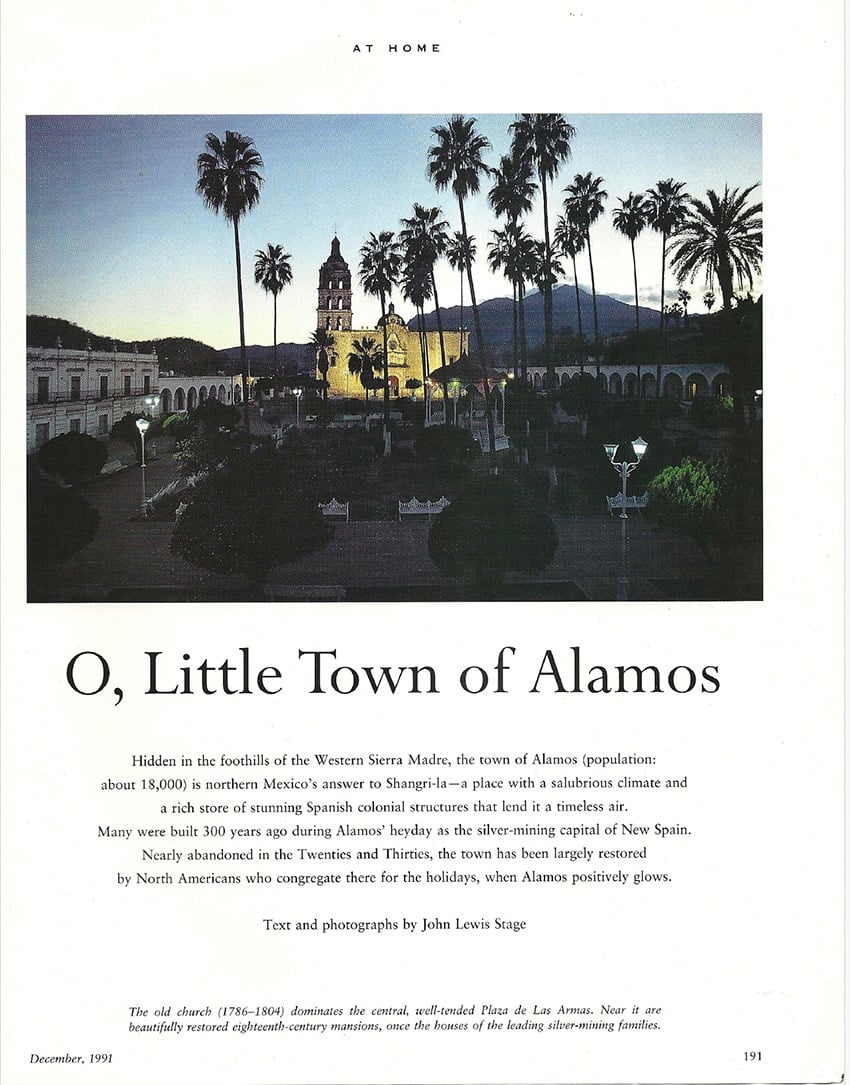
'O Little Town...'
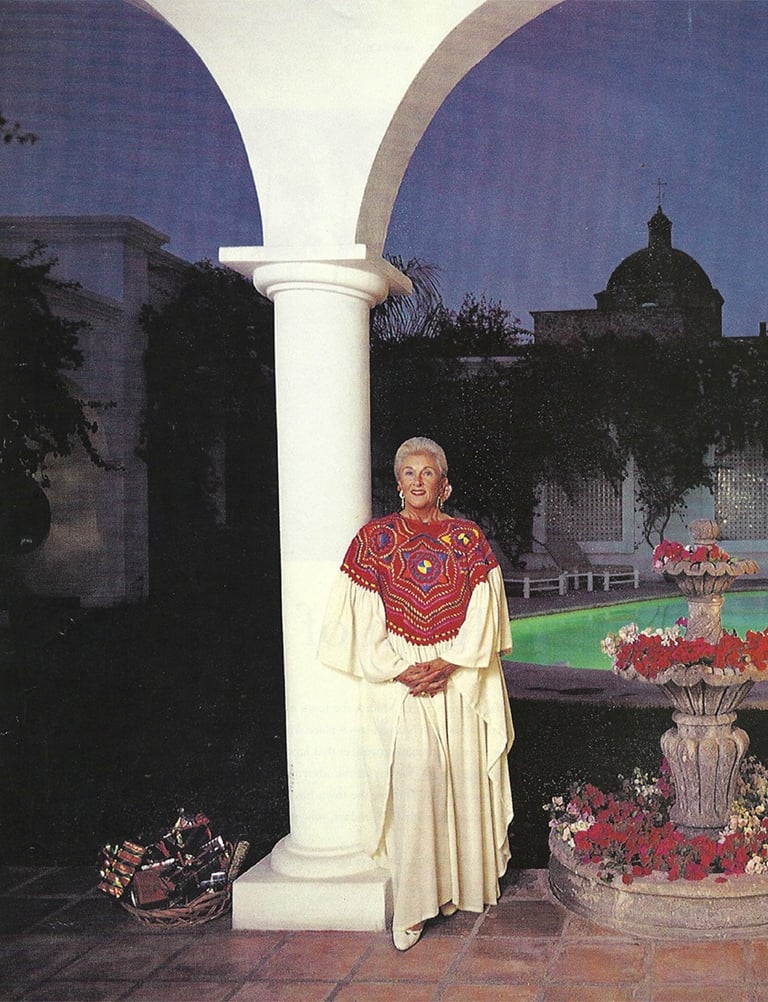
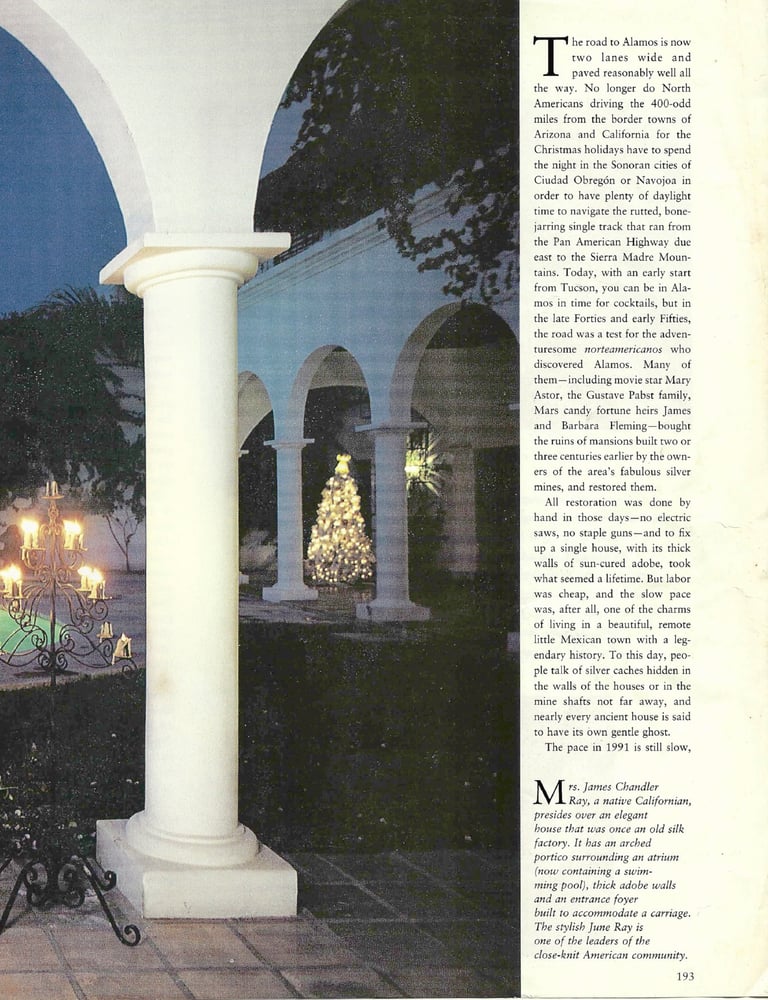
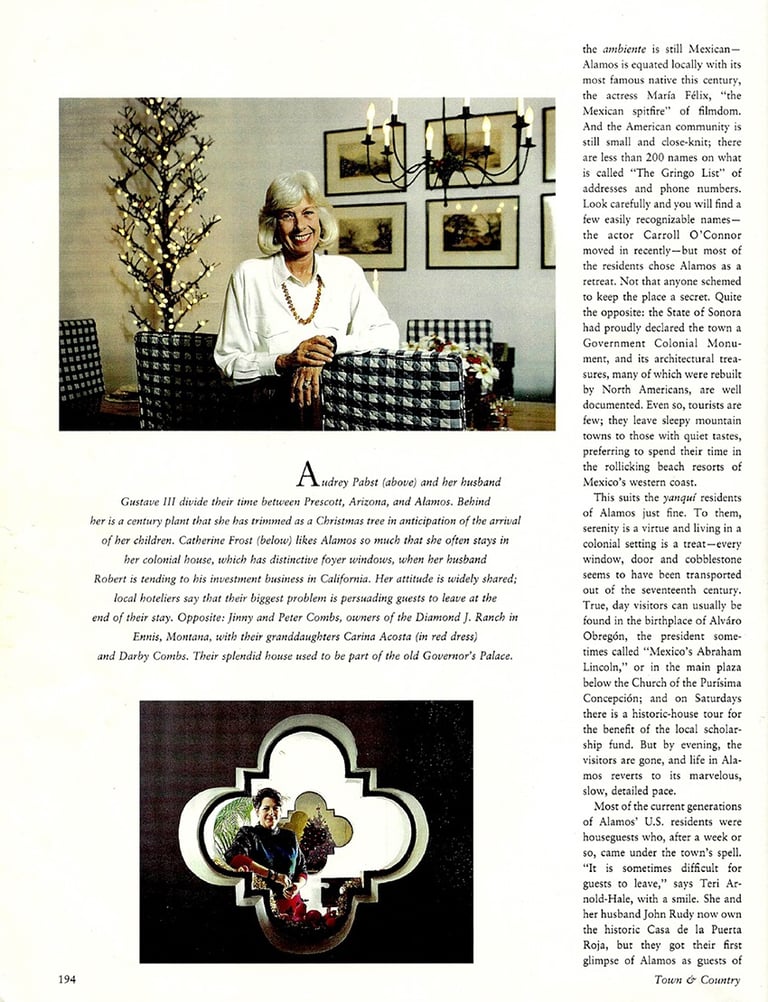
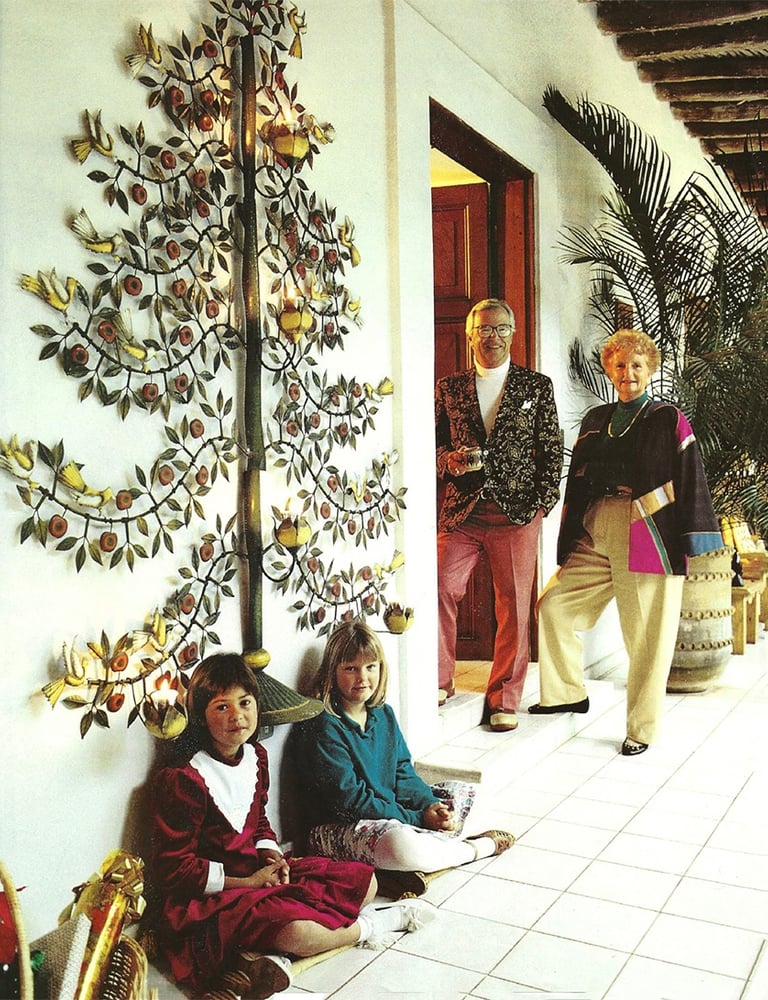
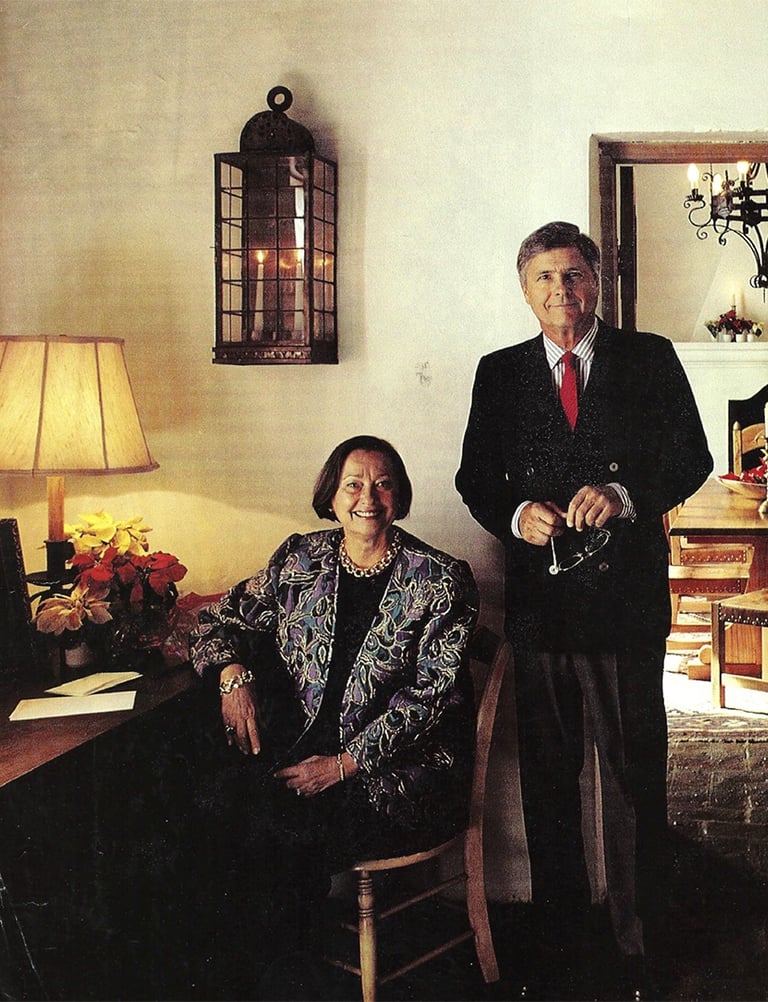
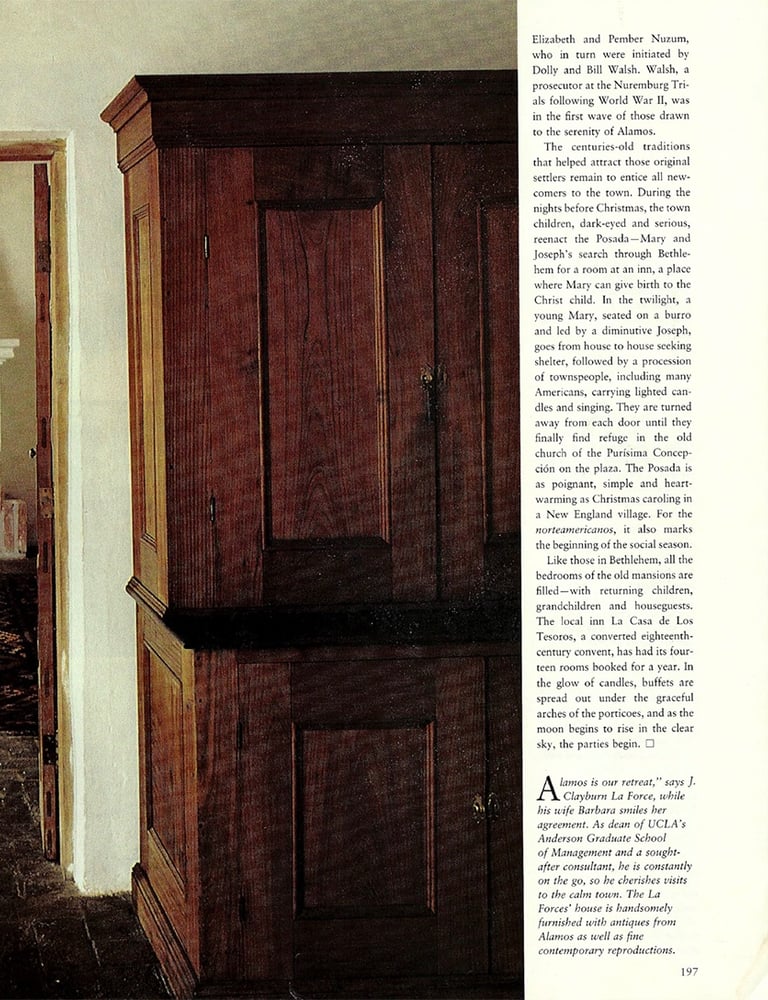
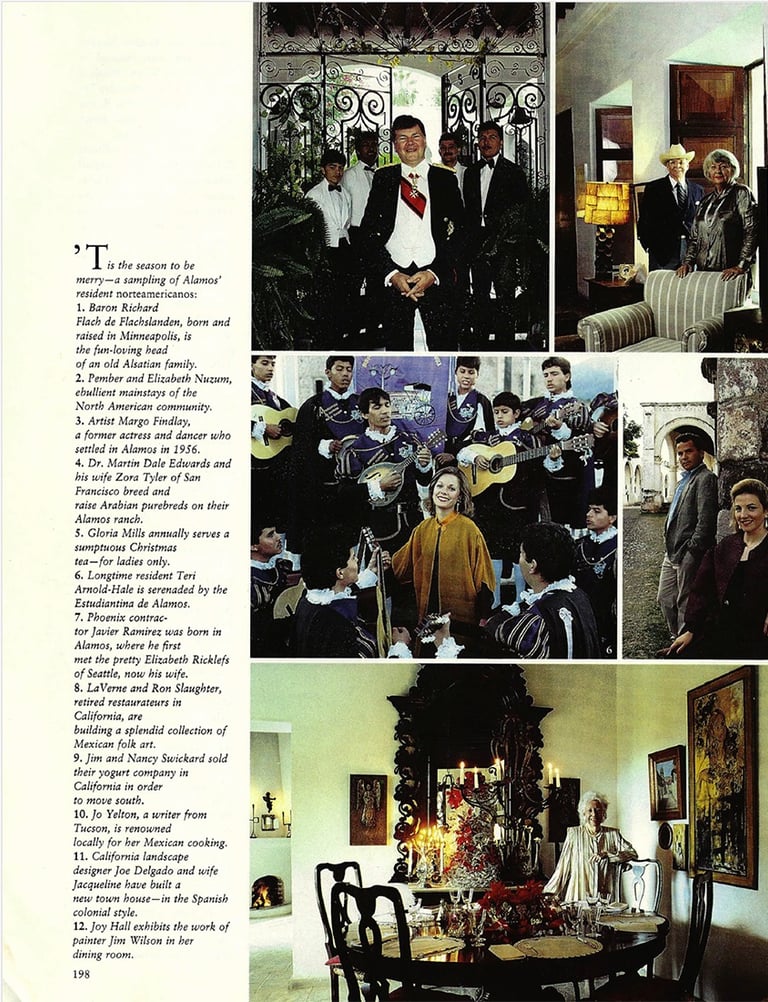
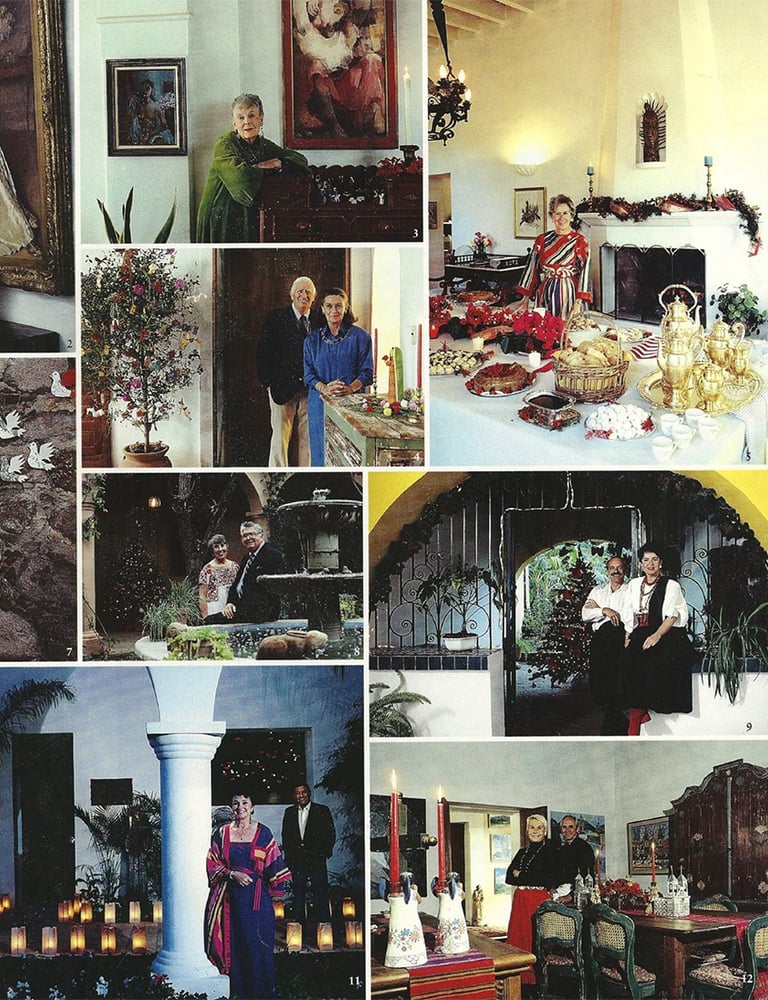
This nine-page article appeared in the December, 1991, issue of Town and Country magazine, and John Lewis Stage, who wrote and photographed this story, probably visited Álamos in December of 1990 to gather information and take the portraits. His portraiture was first-rate with excellent lighting and composition, and—since the magazine subscribers were "people of means"–-the subjects selected were from the "upper level" of the foreign community.
The story had a Christmas theme, warmly comp;aring Álamos to the Bethlehem of Christ's birth. Stage interviewed June Ray, who with her husband James owned the "silk factory" at #1 Obregón, and others quoted were Audrey Pabst, Peter and Jinny Combs, and J. Clayburn and Barbara La Force. A moving account is given of the traditional posada celebrated in Álamos at Christmas, inferring that members of the foreign community opened their homes to their families to celebrate the Christmas tradition together.
Of the Álamos residents who were photographed, only Jim and Nancy Swickard and Teri Arnold remain a part of the foreign community today. Those interviewed and photographed for the story will be remembered by the few who lived here 30 years ago, and some—especially the Combs, the Barron, the Nuzums–-made indelible marks upon Álamos.
The foreign community today seems different from how it was portrayed in this article. There are no international stars such as Mary Astor, Rip Torn, Geraldine Page, or Carroll O'Connor living among us, one never sees Álamos people dressed as those photographed. Our community today, though, remains enthralled by the traditions of Mexico and dedicated to helping the local alamenses.
'The City that
Refused to Die'
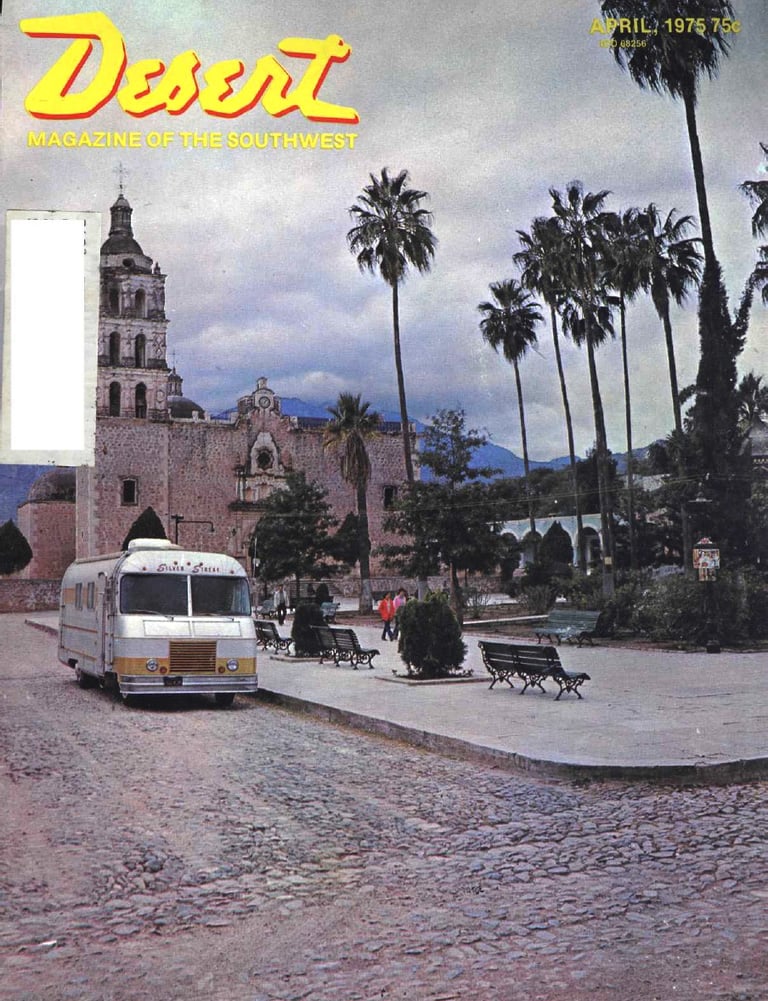
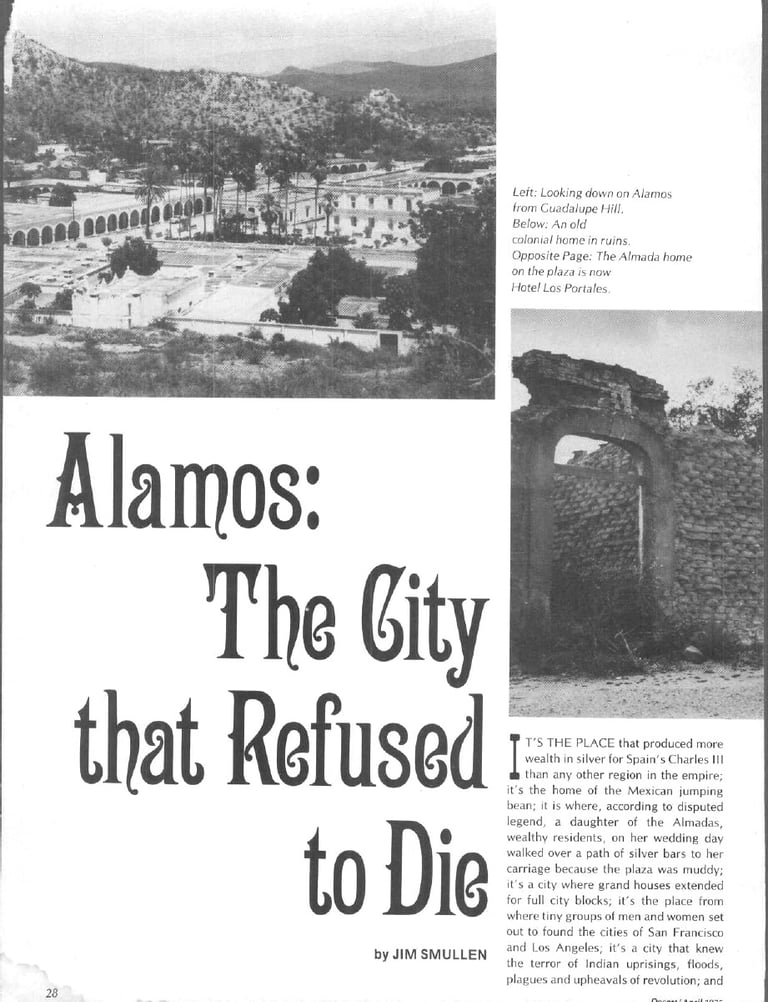
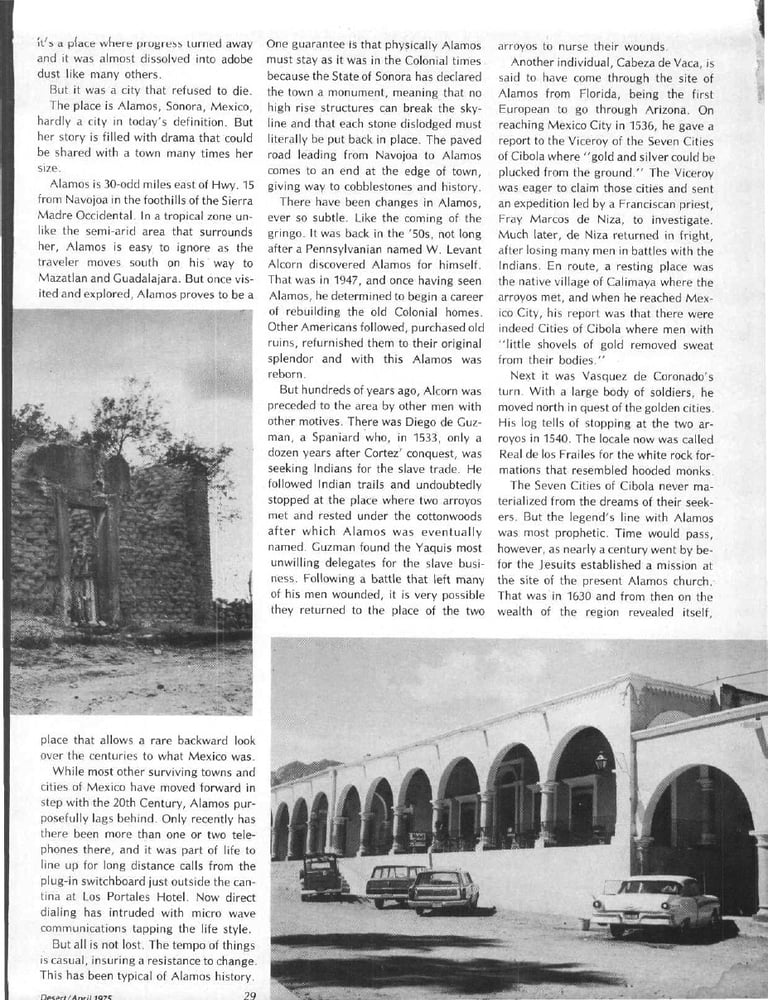
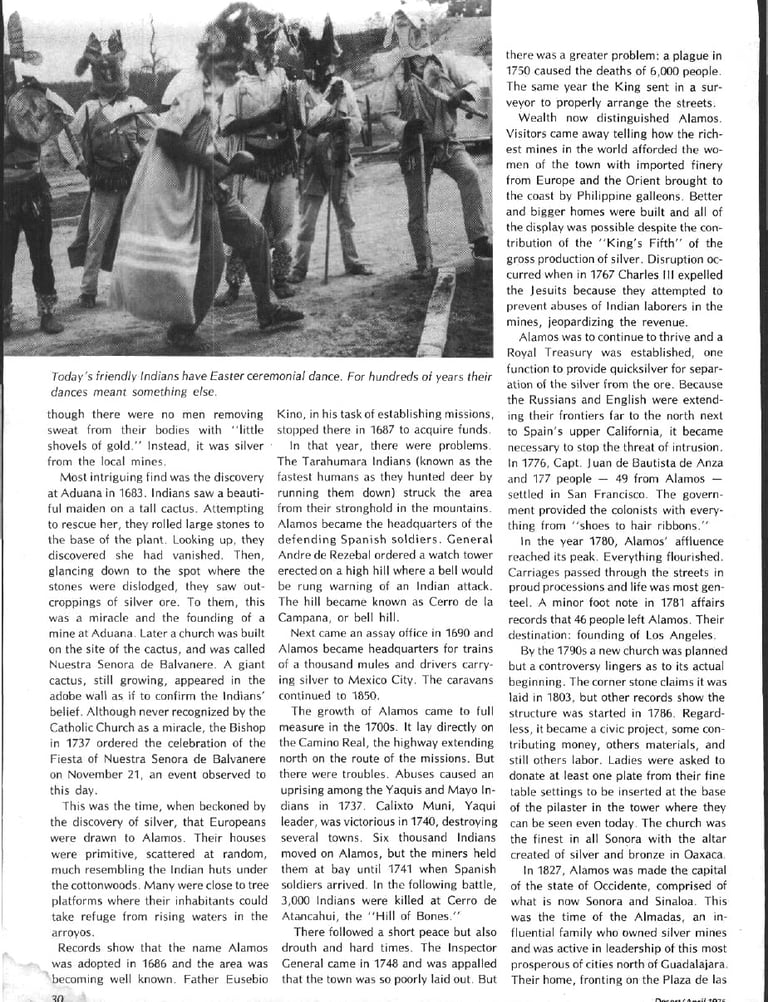
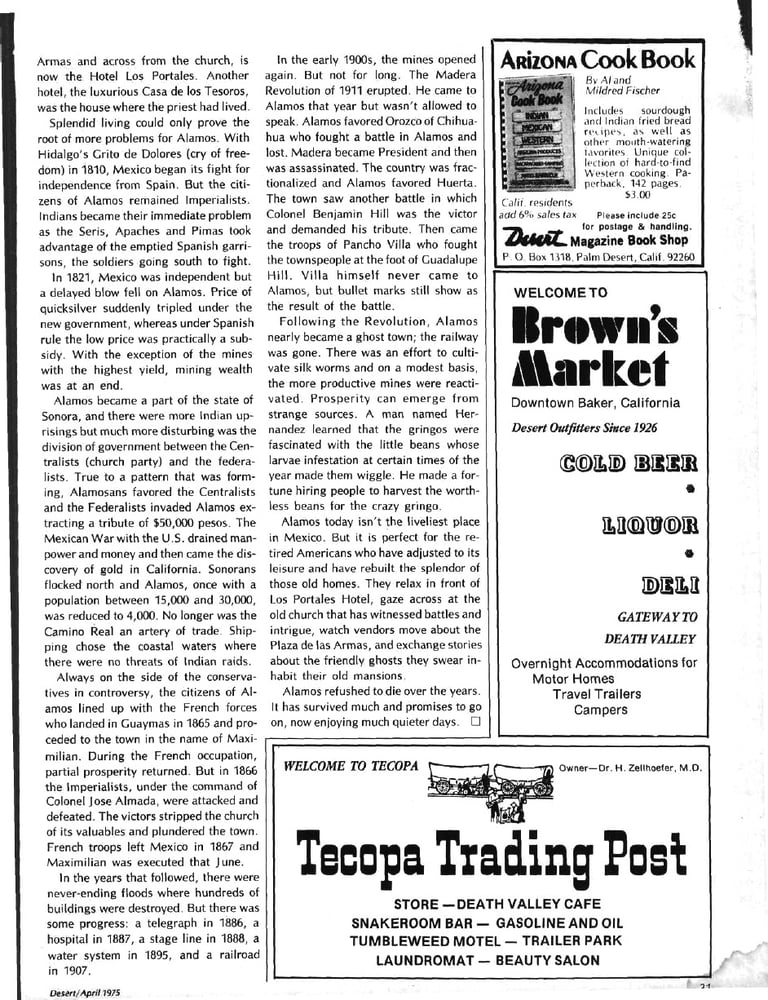
Jim Smullen's generalized summary of the history of Álamos is breezy and interesting—but not necessarily historically accurate. He begins by saying that Álamos produced more silver for the Spanish empire than any other city of Mexico, but that's not correct; Guanajuato receives that honor, with Zacatecas second. He writes of the discovery of silver in La Aduana, the great wealth of the mines, the growth and expansion of the city, and the collapse and deterioration during the revolution. He correctly notes that Álamos has enjoyed periods of great wealth, but also endured periods of great suffering.
His historical account appeared in the April, 1975, edition of Desert magazine, which was devoted to places and things of interest in the U.S. Southwest. He writes to an audience possibly interested in retirement in Mexico, and he discusses Levant Alcorn's visit in 1947 which brought new prosperity to a tranquil village in a beautiful environment. Other norteamericanos followed him, providing jobs for local laborers as well as being enriched by the traditional culture of Mexico.
He concludes as follows:
"Álamos today isn't the liveliest place in Mexico, but it is perfect for the retired Americans who have adjusted to its leisure and have rebuilt the splendor of those old homes. They relax in front of Los Portales hotel, gaze across at the old church that has witnessed battles and intrigue, watch vendors move about the Plaza de Armas, and exchange stories about the friendly ghost they swear inhabit their old mansions.
"Álamos refused to die over the years. It has survived much and promises to go on, now enjoying much quieter days."
________________________
'Solis Garden'
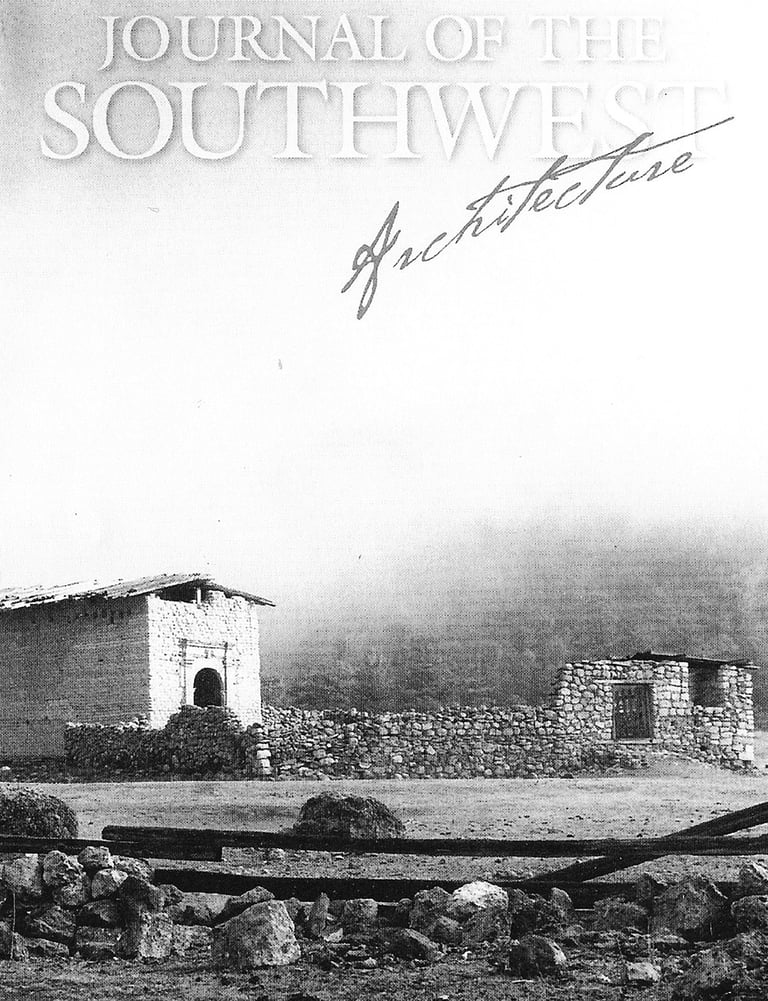
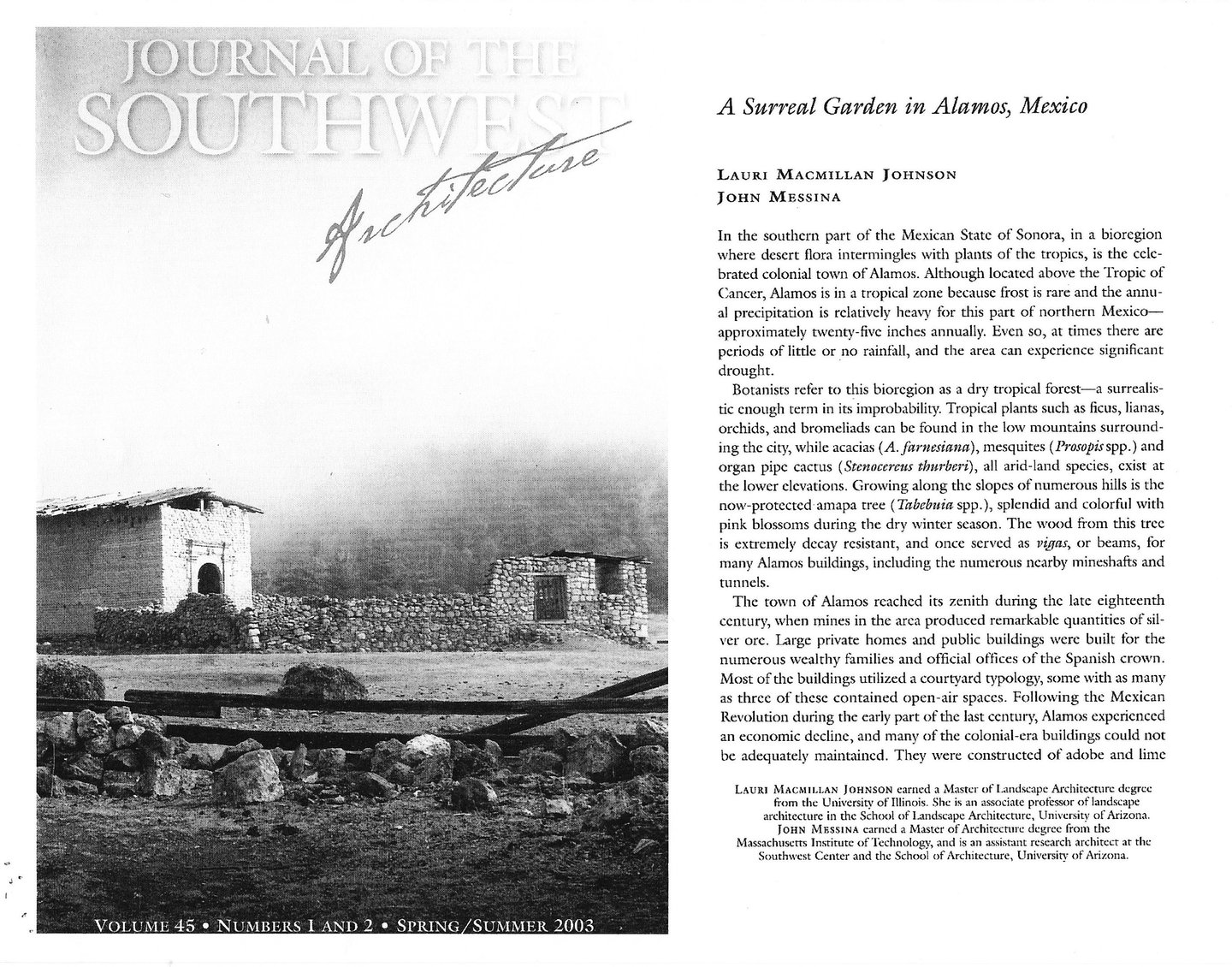
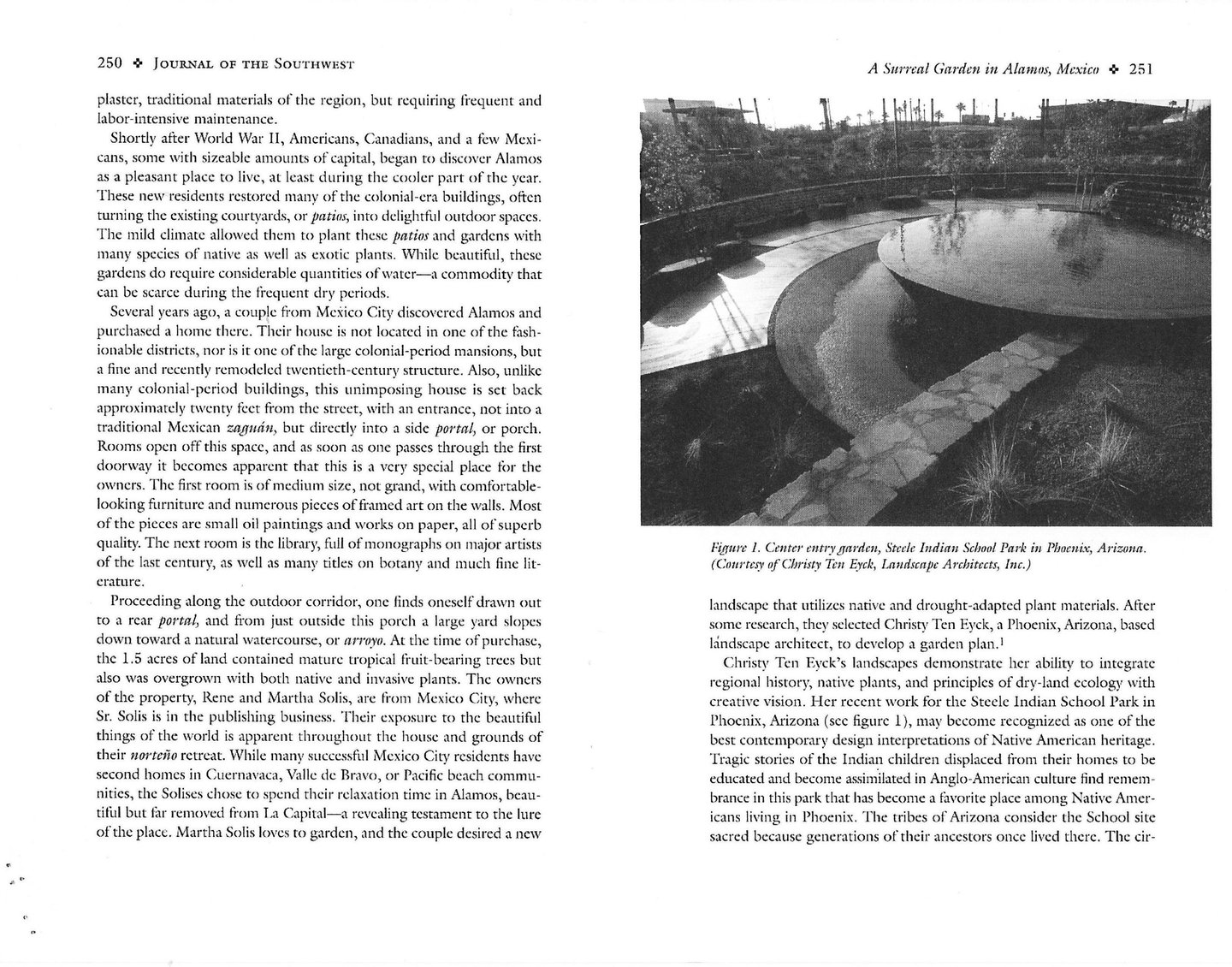
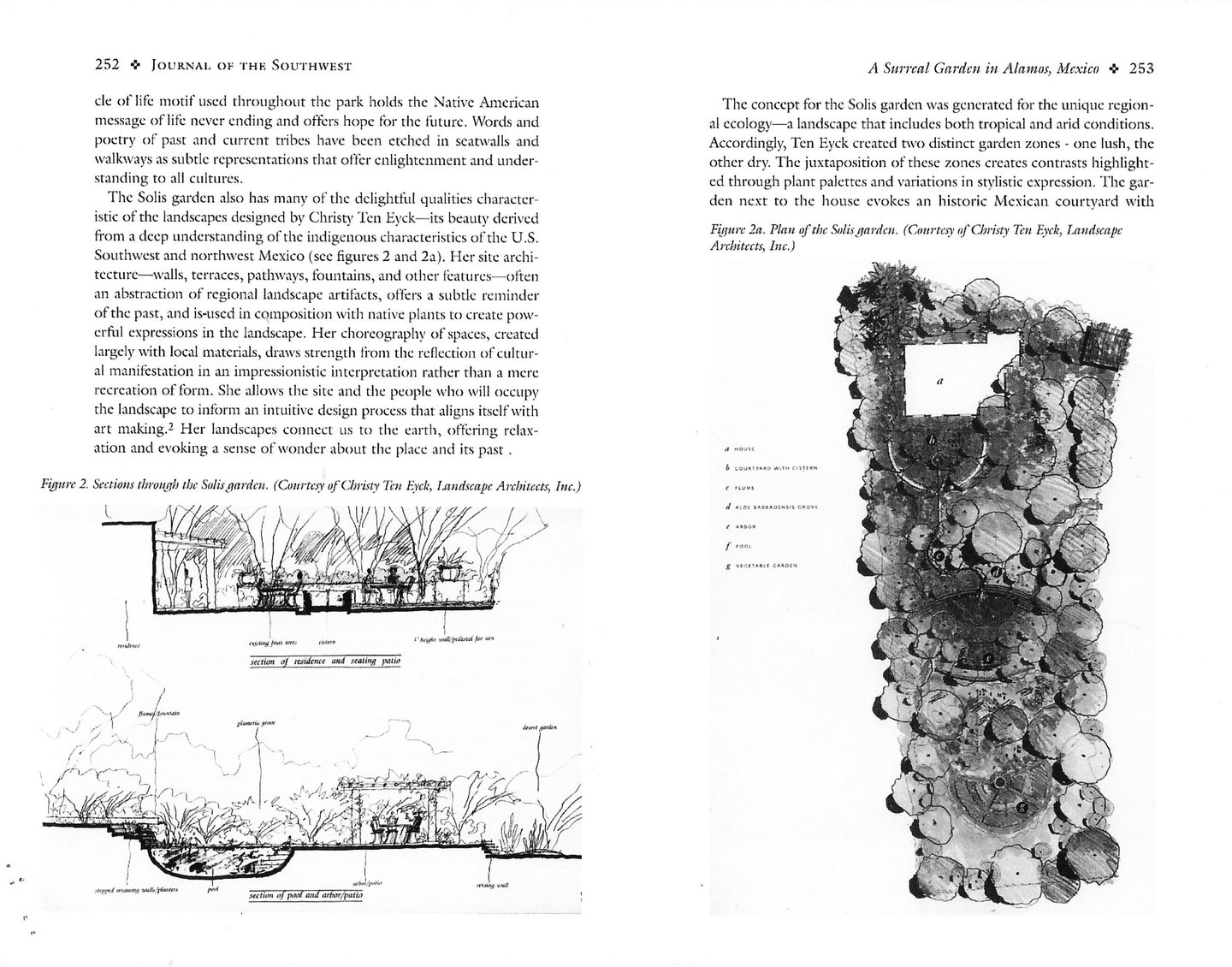
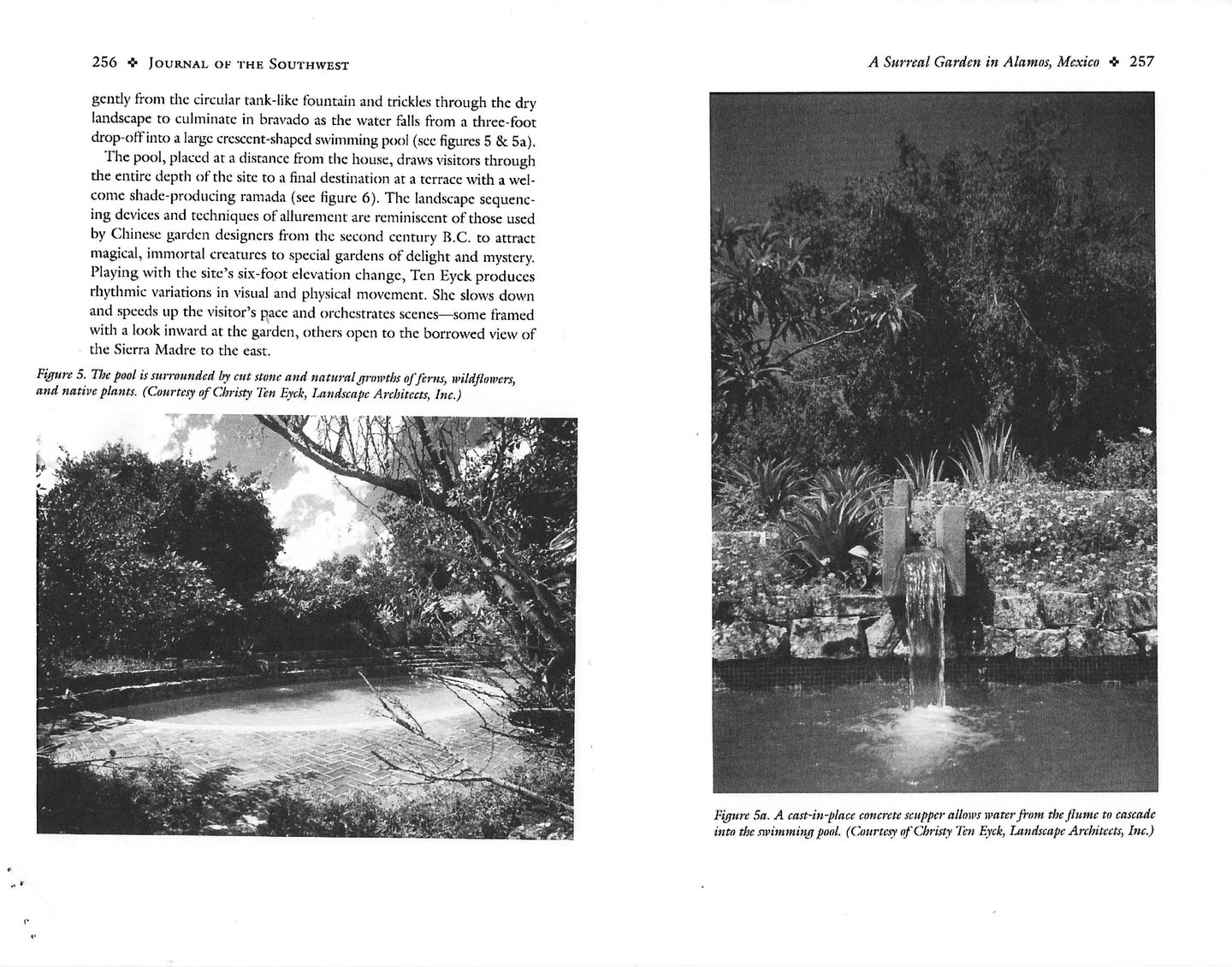
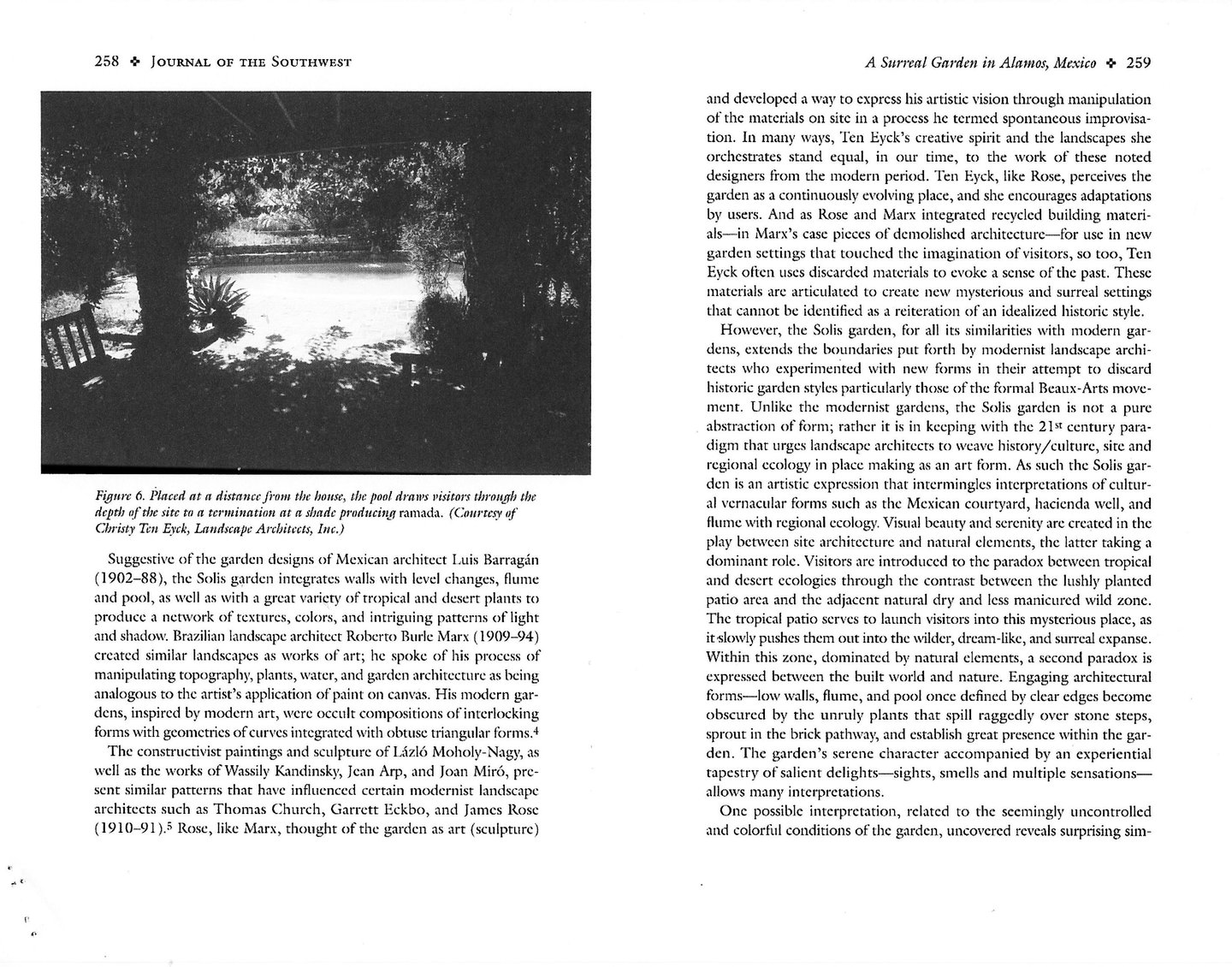
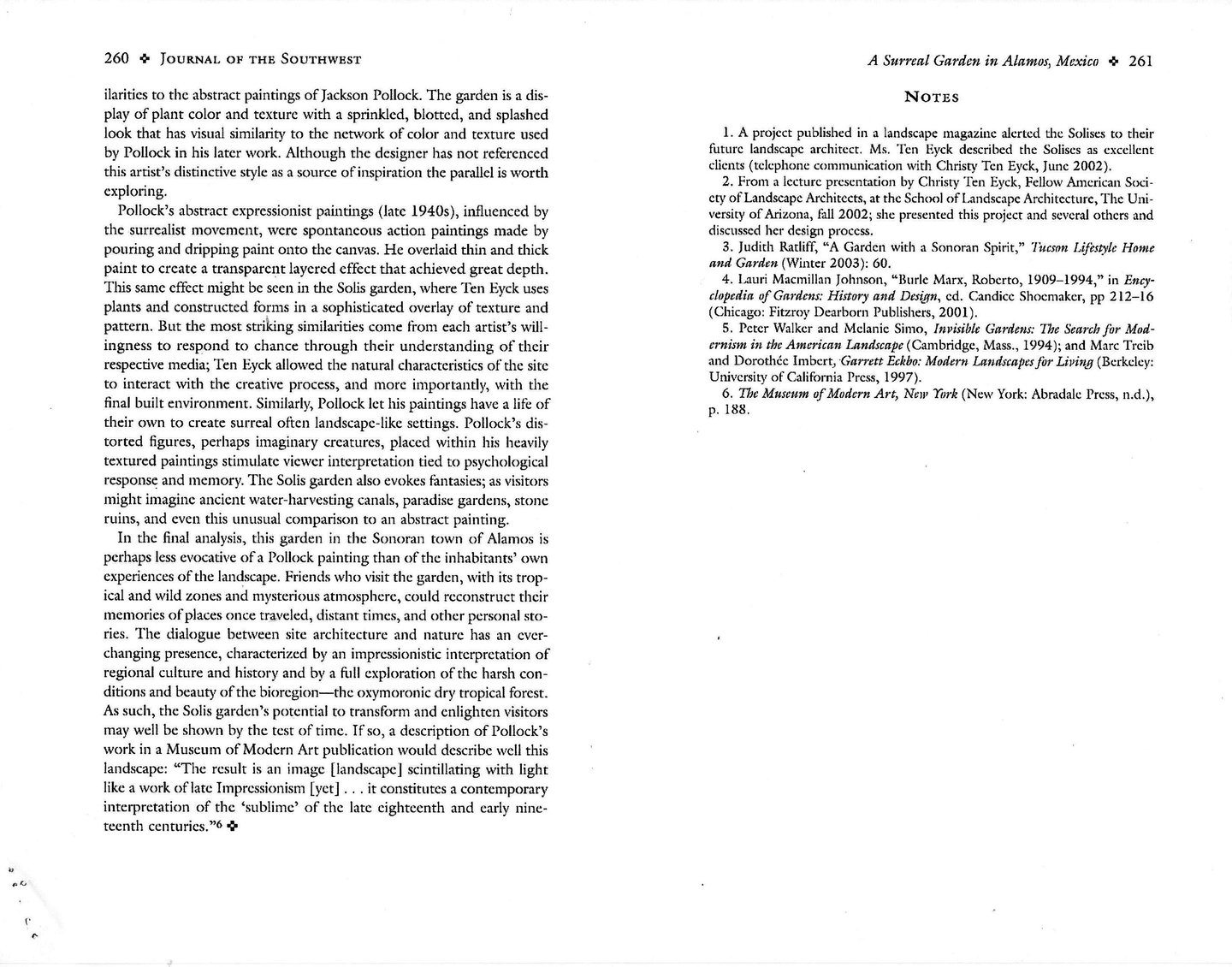
In the 2003 Spring-Summer edition of the Journal of the Southwest, writers Laurie McMillan Johnson and John Mussina describe the garden created by Rene and Martha Solis on their Álamos property. Tne Mexico City couple chose Álamos for their "getaway home" rather than buy a home in Cuernavaca or another location close to the capital. After settling in to their new home Martha, who loves gardens and gardening, decided that their 1.5 acre garden space—then covered with tropical fruit trees and invasive plants—should be transformed into a landscape that utilized native and droughtr-adapted plants. For this project they hired Phoenix landscape architect Christy Ten Eyek to develop a garden plan.
The footnoted article provides much more than photos and a description of the garden. The authors first give a short synopsis of the colonial history of Álamos, including the 20th Century Álamos revival. They discuss the unique characteristics of what is called a "dry tropical forest" and the plants their inhabit this region. They note that Ten Eyek relied on indigenous traditions, common in the US, Southwest and Northern Mexico, in her plan, which included walkways, terraces, walls, and fountains. to create both beauty and solitude. ...."the Solis garden integrates walls with level changes, flume and pool, as well as with a great variety of tropical and desert plants to produce a network of textures, colors, and intriguing patterns of light and shadow," the authors write.
The garden is not open to the public, retaining its original purpose of creating beauty and tranquility by integrating native plants and indigenous architecture.
________________________
________________________